The QCD Triangle: The Key to Successfully Managing Your Projects
Key takeaway: The QCD Triangle (Quality, Cost, Delivery) is a powerful framework for managing project constraints. Mastering these three levers helps prevent budget overruns, align teams, and ensure customer satisfaction. Through Lean Management, Toyota has demonstrated that it is possible to optimize all three dimensions. Ready to take action? Discover our consulting services in operational and organizational management.
Are you juggling tight deadlines, limited budgets, and high customer expectations? The QCD Triangle (Quality, Cost, Delivery), often referred to as the Golden Triangle in project management, provides a roadmap to align these constraints and define the scope of your initiatives. Designed as a decision-making tool, it encourages you to set priorities based on your business objectives while anticipating inevitable trade-offs. Learn how to master this strategic balance to turn challenges into tangible successes, with real-world examples and proven methods. Ready to reconcile ambition with realism while optimizing your resources?
1- The QCD Triangle: the key to successfully managing your projects
2- The three pillars of the QCD Triangle explained
3- Interdependence: the core mechanism of the QCD Triangle
4- How to use the QCD Triangle in your strategy
5- Beyond the myth: can all three dimensions be improved simultaneously?
6- The QCD Triangle in the era of agile methods and the human factor
7- Three common mistakes to avoid with the QCD Triangle
8- When siloed work destabilizes the QCD Triangle
9- Key takeaways to master your projects
The QCD Triangle: the key to successfully managing your projects
When facing time and budget constraints, the QCD Triangle—also known as the Golden Triangle—becomes an essential tool. It connects Quality, Cost, and Delivery to define the scope of your projects.
What exactly is the QCD Triangle?
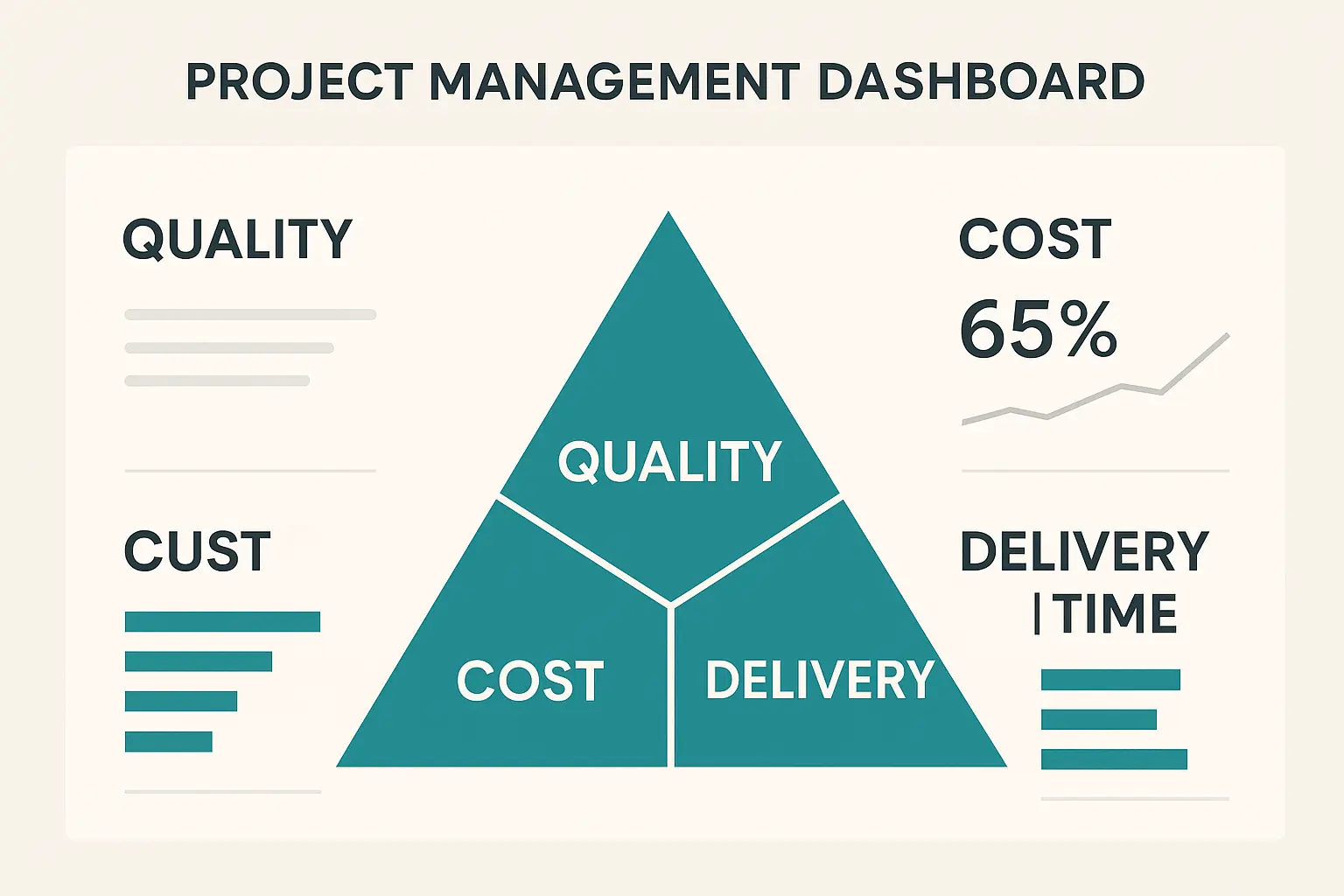
The QCD Triangle is based on three pillars:
- Quality: standards and customer expectations
- Cost: total budget (resources, logistics)
- Delivery: meeting deadlines
Changing one parameter affects the other two. Reducing delivery time can harm quality or increase costs. Improving quality requires additional investment or more time.
Why is it essential for your organization?
As a business leader, the QCD Triangle helps you to:
- Avoid overruns: delays or budget excesses
- Align your teams: prioritize quality for a premium product
- Ensure customer satisfaction: balance requirements and constraints
By integrating this framework, you turn constraints into levers. Automation can reduce costs and lead times without compromising quality. The Golden Triangle guides decision-making and supports sustainable success.
The three pillars of the QCD Triangle explained
Quality: far more than a defect-free product
Quality encompasses compliance with customer expectations, reliability, performance, and user experience. A Canadian company launching an application must ensure an intuitive interface, robust features, and optimal security. These elements define the functional scope: what the final product fulfills.
Poor quality leads to costly rework or negative customer feedback. The Lean method, used by Toyota, shows that quality, cost, and delivery can all improve simultaneously over the long term.
Cost: all resources involved
Cost includes human resources, materials, and ancillary expenses. A Quebec furniture manufacturer must balance wages, local wood procurement, and lead-time optimization to remain competitive.
Underestimating costs can stall a project. Bottom-up methods (task-based estimation) or parametric methods (statistical models) help prevent overruns. Poor cost management compromises both quality and delivery.
Delivery: mastering the race against time
Delivery covers the project duration, from concept to final release. For a Montreal-based SaaS startup, meeting milestones (beta testing, updates) is critical to stay ahead of competitors.
Delays lead to skyrocketing costs or sacrificed quality due to rushed execution. Just-In-Time (JIT) principles improve planning. An agile, time-and-materials project—where the client validates each stage—reduces risk by aligning expectations and deliverables.
Interdependence: the core mechanism of the QCD Triangle
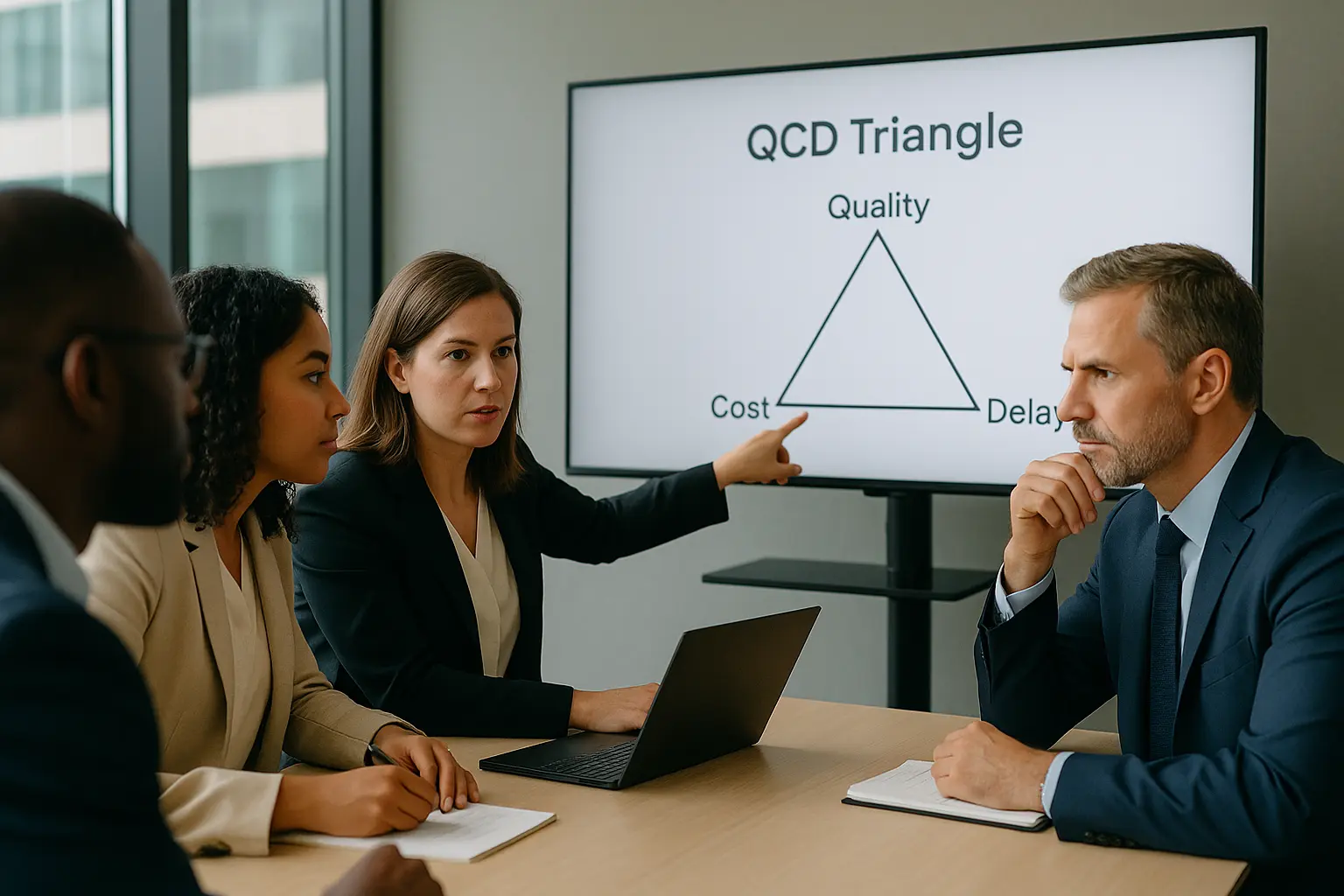
In project management, the QCD Triangle illustrates a simple principle: you cannot optimize everything simultaneously. Picture a three-legged stool—if one leg wobbles, the balance is lost. This model shows that each vertex (Quality, Cost, Delivery) is inseparable from the others. A Quebec company that accelerates a software release (shorter delivery time) must increase the budget or accept incomplete testing. This dynamic applies across all industries, whether it is a furniture manufacturer in Montreal or a fintech company in Toronto.
The QCD Triangle reminds us of a simple truth: in project management, you can’t have it all. Every decision is a strategic trade-off aimed at achieving the best possible balance.
Trade-off scenarios within the QCD Triangle
| If we prioritize… | Then, the likely impact on the other variables is… |
|---|---|
| Quality (enhanced features, improved materials) | Increase in Cost AND/OR Timeline. |
| Cost (budget reduction) | Decrease in Quality AND/OR increase in Timeline. |
| Timeline (accelerated delivery) | Increase in Cost AND/OR decrease in Quality. |
An SME improves a website’s ergonomics (quality) without additional budget. The impact is a longer delivery time, illustrating the importance of trade-offs. This mechanism applies to companies of all sizes, from niche craftsmanship to a clean-energy giant in Alberta.
Why does this model matter to executives? Because it clarifies priorities from the outset. Every decision made on one corner of the triangle affects the other two. In the case of budget reductions, for example, declines in quality or extended delivery times are often observed. This delicate balance determines operational success in an environment where customer expectations are constantly evolving. For a Canadian company, mastering this tool means anticipating the financial consequences of strategic choices before they become critical.
How to use the QCD Triangle for your strategy?
The QCD Triangle (Quality, Cost, Delivery), also known as the Golden Triangle, aligns with your business strategy and market expectations. Every strategic decision involves trade-offs between these three pillars. Understanding and mastering their interdependencies allows you to structure your projects around your business objectives.
Cost-driven strategy: Adopted by low-cost brands or discount retailers, this approach focuses on cost optimization, often at the expense of quality (paid options) or delivery times (simplified processes).
Example: A Quebec-based company reduces costs by limiting finishing touches and attracting price-sensitive customers.
Source: organisologie.com.
Quality-driven strategy: Essential in critical industries (medical, aerospace), where reliability justifies higher costs and longer timelines. A Montreal-based company may spend years developing products under strict controls to avoid defects.
Delivery-driven strategy: A priority in e-commerce (express delivery) or media (speed of publication), where rapid execution justifies higher logistics costs. A Toronto-based platform offers one-hour delivery supported by additional teams.
To apply the QCD Triangle, identify the non-negotiable constraint: fixed budget, mandatory deadline, or strict quality requirement. Then adjust the other two parameters accordingly. For example, a Canadian software project with a short deadline may require additional costs (external developers) or a simplified scope (prioritizing core features). This balance optimizes customer value while remaining consistent with your market positioning.
Anticipate risks: ignoring the links among quality, cost, and delivery can lead to budget overruns or delays. A Montreal company that accelerates timelines by outsourcing to low-cost partners risks costly defects later. The QCD Triangle then becomes a strategic arbitration tool tailored to your industry.
As Michel Boudreault points out in his LinkedIn post, to choose is to renounce.
Beyond the myth: can all three dimensions be improved simultaneously?
Many see the QCD Triangle as a “triangle of doom,” where improving one dimension always comes at the expense of the other two. This view, however, deserves nuance. What if innovation made it possible to overcome this fatalism?
Operational excellence is not about choosing between quality, cost, and delivery, but about redesigning processes so that improving one naturally enhances the others.
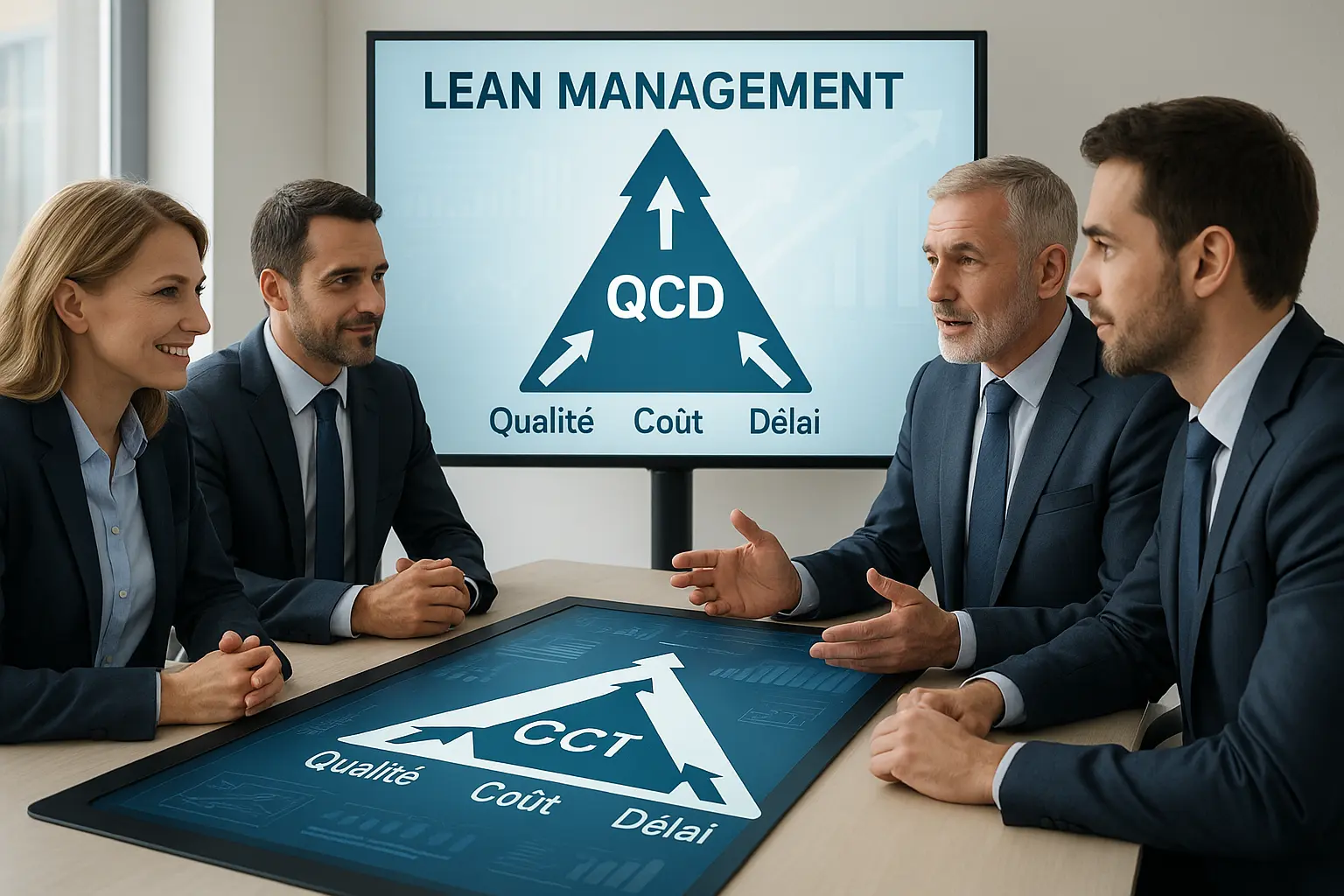
Reality is more optimistic than it seems. Through continuous improvement, it is possible to progress across all three dimensions. Lean Management, popularized by Toyota, perfectly illustrates this potential. By eliminating waste, organizations improve quality, reduce costs, and accelerate delivery.
When errors are corrected at the source, costly rework and delays are avoided. Well-designed, automated processes enable companies to win on all fronts. This is exactly what organizations adopting this approach demonstrate.
Technological innovation also plays a key role. Generative AI tools, for example, are transforming project management by enabling real-time adjustments without compromising quality or budget. Discover how modern organizations are rebalancing this triangle.
The QCD Triangle in the era of agile methods and the human factor
The QCD Triangle, a historic symbol of project management constraints, is evolving to meet modern challenges. Did you know that agile methods are reshaping its rules?
In traditional approaches (Waterfall or V-model), quality is defined upfront. Cost and delivery adjust to meet that objective. This model remains relevant for stable projects but is limited in an increasingly uncertain environment.
Agile methods reverse this logic. In Scrum, for example, teams fix cost (team size) and delivery time (sprint duration), while scope and perceived quality become the adjustable variables. This is a radical shift: the goal is to maximize delivered value within fixed constraints.
Traditional approach (Waterfall): Scope is fixed. Cost and delivery estimates are subject to change. The objective is to deliver the full predefined scope.
Agile approach (Scrum): Cost (team size) and delivery time (sprint length) are fixed. Scope is flexible and adjusted to deliver maximum value at each iteration.
This flexibility is not without risk. The human factor remains central: excessive pressure on cost or deadlines can lead to burnout. Exhaustion directly impacts quality, slows delivery, and increases hidden costs (absenteeism, repeated errors).
By combining agility with human-centered management, organizations avoid the traps of the “triangle of doom.” A calm team, working with realistic sprints, produces more, better, and faster. Ready to reinvent your project management approach?

Three common mistakes to avoid with the QCD Triangle
Did you know that most project failures stem from poorly defined scope? The QCD Triangle (Quality, Cost, Delivery), or Golden Triangle, is a key tool to prevent these failures. Here are the mistakes to avoid to maintain project balance.
1- Defining an unrealistic scope: the “five-legged sheep” myth
Demanding exceptional quality, fast delivery, and minimal cost is a common mistake. For example, a real estate project using premium materials, with a tight budget and short deadline, will inevitably lead to delays, budget overruns, or reduced quality. The QCD Triangle requires trade-offs: changing one corner destabilizes the other two.
2-Ignoring scope creep
Accepting unplanned features without adjusting cost or delivery is risky. In SME software projects, each unanticipated addition slows deployment and increases expenses. Every change must be assessed upfront, not improvised.
3- Neglecting communication
The QCD Triangle is not static. Without regular dialogue with stakeholders, improvements (such as higher environmental standards) can generate hidden costs or delays. The Golden Triangle must be a tool for active negotiation, not a rigid constraint.
By avoiding these mistakes, the QCD Triangle becomes a strategic lever. It is not about enduring constraints, but about using them to guide decisions. Reduce risk and maximize success by mastering these pitfalls. Ready to optimize your projects?
When siloed work destabilizes the QCD Triangle
The QCD Triangle is often compared to a three-legged stool: if one leg gives way, the entire balance collapses. Yet in many organizations, an invisible factor constantly weakens this strategic structure: working in silos. This fragmented mode of operation prevents smooth information flow and creates disconnects where coherence should prevail.
When teams operate in isolation, quality is the first casualty. Customer messaging becomes inconsistent, decisions lack a global perspective, and the value proposition weakens. On the cost side, poor coordination leads to major inefficiencies: duplication, delays, avoidable errors—hidden expenses that erode profitability. As for delivery timelines, they inevitably extend when projects lack real alignment, with each team pursuing its own priorities.
For executives, the risk is clear: allowing managers to protect their own territories turns the QCD Triangle into a strategic trap. Conversely, fostering cross-functional collaboration restores balance and overall performance.
In practical terms, this means:
- shared objectives across teams,
- cross-functional coordination rituals,
- a management culture focused on collaboration rather than control.
By breaking down silos, you do more than simplify project management: you secure sustainable performance and restore the full stability of the QCD Triangle.
Key takeaways to master your projects
The QCD Triangle is not a rigid constraint, but a decision-support tool designed to align priorities. Any change to one parameter (quality, cost, delivery) affects the other two. For example, accelerating a project without sacrificing quality often requires additional resources, increasing costs.
But did you know this interdependence can become a strategic lever? By optimizing one dimension, you can create a virtuous circle. Improving quality reduces rework, lowers costs, and accelerates delivery. This is exactly what Toyota demonstrated through Lean, proving that a win-win balance is possible.
Ready to shift from reactive management to strategic steering?
To take the next step and benefit from tailored support, explore our operational and organizational management consulting services. Let’s build the roadmap to your success together.
The QCD Triangle is a flexible strategic steering and decision-making tool. Mastering its balance transforms your projects into growth drivers. Ready to reinvent your project management? Discover our operational consulting services.