Succeeding with Your Business Growth Strategy in Canada
Is your SME stagnating dangerously while competitors actively capture your market share? In business, lack of progress equals decline, making the adoption of a growth strategy imperative for long-term sustainability and profitability. Analyze the four fundamental levers of the Ansoff matrix and the necessary trade-off between organic development and strategic acquisitions to structure your expansion effectively. You will discover how to leverage your technological foundation to drive superior returns and how to navigate Canadian regulatory specifics to build a resilient organization capable of facing future financial challenges.
1- Propel Your Business with the Ansoff Matrix
2- Choosing Between Organic Growth and Strategic Acquisitions
3- Anticipate Financial Risks and Operational Constraints
4- Align People and Technology with Your Performance Objectives
5- Succeeding in Your Expansion Across the Canadian Market and Its Provinces
Propel Your Business with the Ansoff Matrix
With your company’s growth challenges identified, explore concrete actions to accelerate your commercial performance.
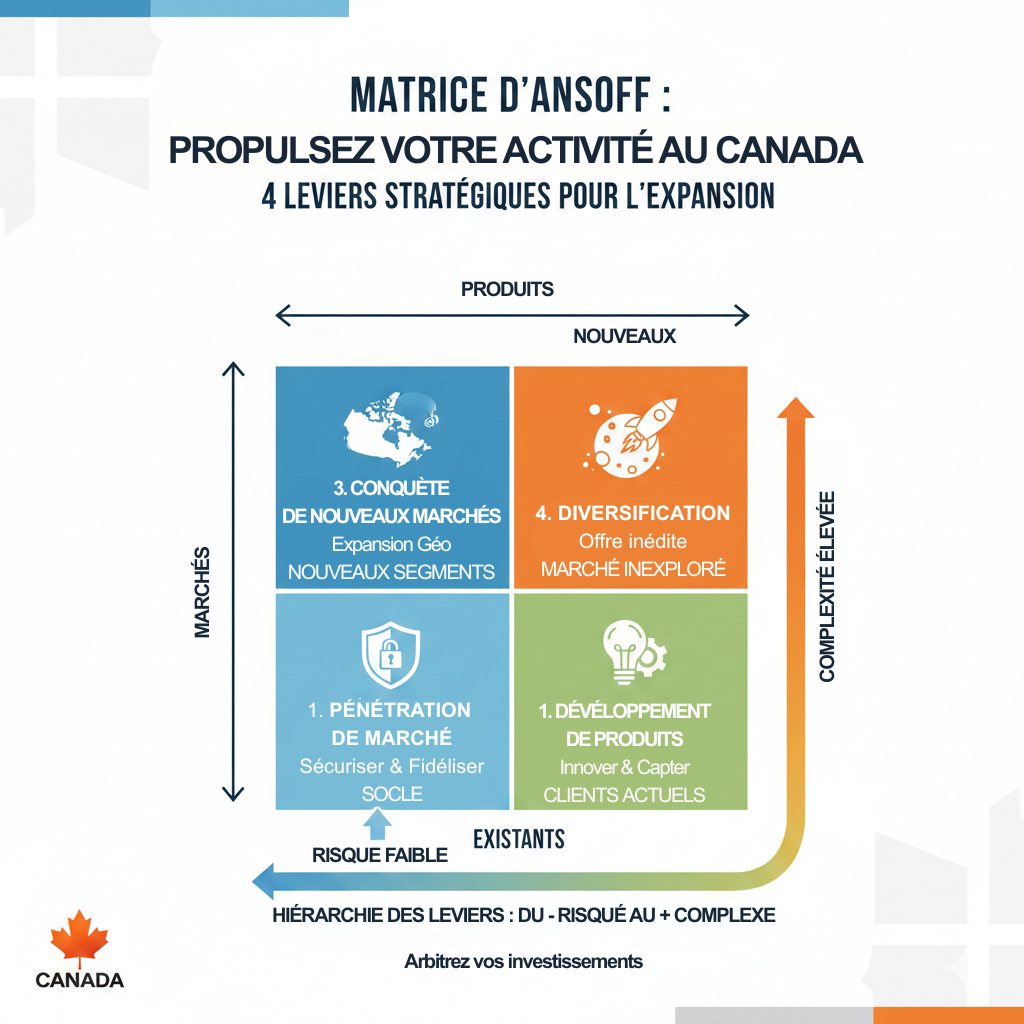
Market Penetration: Secure Your Core Before Expanding
Selling more to your existing customers forms the foundation of your progress. For an SME, this business growth strategy limits financial risk. Start by building unwavering customer loyalty.
Execution discipline is critical. Simple actions can secure your foundations and prevent costly operational mistakes. Here are key priority levers:
- Improve your value proposition
- Monitor competitive gaps
- Strengthen service quality
Increasing your market share helps stabilize the company during periods of turbulence. Dominating your local sector remains a strategic imperative.
Product Development: Innovate to Capture New Needs
Creating complementary offers leverages your brand’s strengths. You launch new solutions without starting from scratch. This engine of organic growth is particularly powerful.
From an operational standpoint, isolate innovation teams to protect daily workflows. Testing prototypes on limited segments reduces financial exposure and prevents costly failures. Rigor ensures sustainability.
Listening to market feedback also allows you to refine the offer before full deployment. Specialists such as ACM Canada support you step by step, ensuring innovation remains pragmatic and profitable.
Market Development: The Bold Move of Geographic Expansion
Targeting new territories or demographic segments transforms your company’s scale. Internationalization becomes a critical issue. Risk increases—but revenue potential expands significantly.
Use local statistics to validate your expansion zones. Data from Statistics Canada proves particularly valuable here. Then adapt your distribution to the specific purchasing behaviors of targeted regions.
Consult these SME growth strategy solutions to structure your approach. Each province requires a tailored marketing strategy. Do not simply replicate your existing methods. Ready to give your expansion new momentum?
Choose Between Organic Growth and Strategic Acquisitions
Once your business growth strategy is initiated through Ansoff’s framework, a key question remains: should you build this growth internally or acquire it in the marketplace?
The Steady Strength of Internal Growth
Organic growth relies on your internal capabilities. It fosters skill development and process optimization. While gradual, this path guarantees genuine structural stability.
Organic growth enables you to maintain full control over the evolution of your corporate culture without heavy external capital injections.
You preserve your identity. Independence is the guiding principle. Leadership retains control.
From a financial perspective, autonomy takes precedence. This model limits excessive debt and reduces the risk of financial strain.
Acceleration Through Acquisition: Opportunities and Cultural Challenges
Acquiring a competitor instantly boosts your revenue volume. You gain market share without years of prospecting. This shortcut is ideal for scaling rapidly.
However, human friction is a significant risk. Value misalignment often undermines promising collaborations. Cultural integration must be handled carefully. Retaining key talent requires authentic communication and a shared vision across all employees.
Success depends on prior organizational readiness. A healthy foundation absorbs new teams more effectively. Review the importance of structure to successfully prepare for this leap.
Balance Autonomy and Strategic Acquisition Based on Your Resources
Time-to-market constraints may dictate your decision. Developing a solution internally takes months. An acquisition provides immediate access but has a significant impact on cash flow.
Your decision will therefore depend primarily on the liquidity you have available.
| Critère | Croissance Interne | Acquisition Externe |
| Coût initial | Faible / Étalé | Élevé / Immédiat |
| Vitesse de déploiement | Lente | Rapide |
| Risque culturel | Nul | Élevé |
| Contrôle opérationnel | Total | À reconstruire |
This table summarizes the financial and operational trade-offs. Carefully compare both options before making a final decision.
Objectively assess the viability of your target. Use rigorous valuation tools to determine a fair price. Never overpay out of a simple desire to rapidly expand your business.
Anticipate Financial Risks and Operational Constraints
Wanting to grow is one thing, but without tight cash flow management, expansion can quickly turn into a fatal trap for your SME.
Cash Flow Management During Hypergrowth
Monitoring working capital remains imperative. Expansion often consumes liquidity long before it generates real profits. Extended payment terms can quickly suffocate a fast-growing SME.
Anticipate your future banking needs. Negotiate credit lines well before urgency arises. Use rigorous financial indicators to detect early signs of liquidity declines. These tools allow you to manage your expansion with confidence.
Consult our guide on balancing growth and profitability. Maintaining this equilibrium ensures operational sustainability. Balance is the absolute key to survival.
Improving Efficiency to Support Increased Sales
Automate your processes to efficiently absorb workload. Manual methods severely hinder scalability. Eliminate all waste to actively protect your current profit margins.
Delegate recurring tasks to free up executive time. Your managers must be fully accountable for their results. Otherwise, the CEO becomes the primary bottleneck—blocking your business growth strategy.
Adopt a disciplined operational approach with your teams. This method enables you to maintain formidable agility. Key priorities include:
- Improving workflow efficiency
- Reducing operational costs
- Ongoing training
Align People and Technology with Your Performance Objectives
For the organization to function efficiently, your tools and teams must evolve in line with your strategic vision.
Recruitment and Retention: The Talent Shortage Challenge
Anticipating tomorrow’s workforce needs becomes a top priority. Recruitment must precede your scale-up phase. In today’s Canadian environment, finding top talent requires significant patience.
Retaining your workforce stabilizes the structure and costs far less than constantly recruiting. Interim management can serve as a valuable transitional support, helping the company navigate structural milestones that often shake its foundations.
The human strategic lever remains central to your growth strategy. Genuine team engagement drives sustainable—and creative—growth. That is where your true strength lies.
Artificial Intelligence as a Strategic Decision-Making Engine
Centralize your data immediately. A single source of truth ensures reliable analytics. Artificial intelligence is ineffective if your foundational data is unclean or poorly structured.
Deploy high-performance decision-support tools. AI segments your customer base and optimizes investments with surgical precision. A scalable ERP system must support every stage of your growth to avoid future technical bottlenecks.
AI reduces forecasting errors. This lever is critical to your business growth strategy, especially for SMEs ready to take this necessary technological step.
Preserve Corporate Culture Despite Workforce Expansion
Communicate your vision with conviction. Every new hire must internalize your core values. Culture acts as the cement that prevents your organization from crumbling during expansion.
Break down silos immediately. Encourage cross-functional collaboration across departments. Rapid growth often creates invisible communication barriers. These must be actively dismantled to maintain full agility and team cohesion.
Succeeding in Your Expansion Across the Canadian Market and Its Provinces
Keep in mind that Canada has its own rules of the game, where sustainability has become an essential selection criterion.
Navigating Provincial and Cross-Border Regulations
You must adapt your deployment strategy to the Quebec market. Legal and linguistic barriers are very real. Ignoring these specifics can abruptly paralyze your commercial progress in this territory.
Seek institutional support. Export Development Canada (EDC) offers valuable financial guarantees. Also, protect your intellectual property without delay. Opening offices requires rigorous administrative compliance to avoid legal setbacks.
A rigorous strategic planning process is essential for your business growth strategy. Expert guidance genuinely secures your regulatory pathway. Leave nothing to chance in your administrative procedures.
Integrate CSR as a Long-Term Competitiveness Lever
Adopt sustainable and transparent practices now. Canadian investors closely scrutinize ESG criteria. This is no longer optional—it is a guarantee of long-term viability.
Highlighting your commitment to society helps attract young talent. Turn environmental constraints into real opportunities for differentiation. Against traditional competitors, your ethical positioning becomes a powerful asset. It represents a solid growth engine.
Obtain growth strategy advisory services to structure your approach. Contact our experts to build a responsible business model. Together, we will secure your commercial success.
Mastering your business growth strategy requires balancing market penetration and acquisitions while safeguarding cash flow. By structuring your operational levers today, we propel your ambitions toward tangible results. Adopt rigorous planning now to build the high-performing future your organization deserves.